
You finished a strong quarter. Jobs were busy, invoices went out on time, and revenue on the profit and loss looks healthy. Yet you open the aged receivables report and see the same names sitting at 45, 60, even 90 days. Meanwhile suppliers are nudging for payment, and you are deciding which bill can wait another week.
Nothing in that picture says the business is failing. It says cash is tied up somewhere between work done and money in the bank. That lag is what working capital is about.
Working capital, in everyday terms, is the money sitting in the operating cycle: stock you have paid for but not yet sold (if you hold inventory), invoices customers have not paid yet, and the bills you have not paid your suppliers yet. The timing between those pieces decides how fast cash comes back to you. Revenue recognises the sale; cash arrives only when the customer pays.
What the cash conversion cycle measures
The cash conversion cycle (often shortened to CCC) is a single number that summarises that timing. It answers: roughly how many days does cash stay locked inside the business before it returns to the bank?
The formula is:
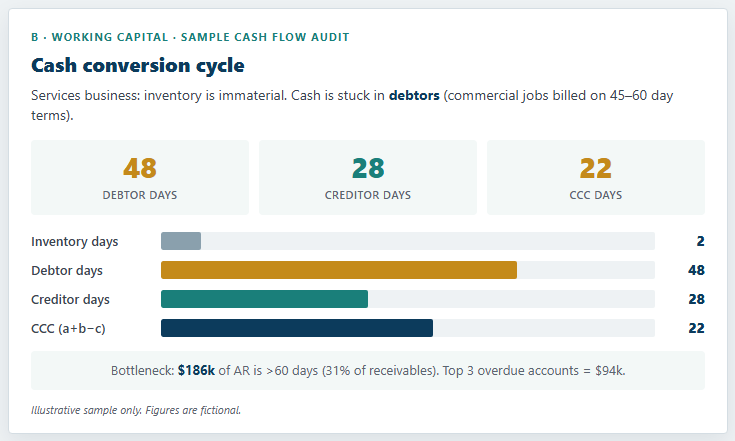
Inventory days + debtor days − creditor days = cash conversion cycle
Each part needs a careful definition.
Inventory days estimate how long stock sits before it is sold. Cash leaves when you pay for materials or goods and only returns when a customer pays for the sale. A services business with little or no stock will often treat inventory days as zero or immaterial; the story then sits almost entirely in debtors and creditors.
Debtor days estimate how long customers take to pay after you invoice them. An unpaid invoice is not cash. It is a promise with a date that may slip. Higher debtor days mean more of your money is parked in receivables.
Creditor days estimate how long you take to pay your own suppliers. Longer creditor days mean you hold onto cash longer before it leaves, which shortens the cycle. That can help short term, but stretch suppliers too far and relationships or supply suffer. If debtors are stretching at the same time, you can end up funding someone else’s cash flow with your own.
A shorter cash conversion cycle means cash comes back faster. A longer cycle means more of your money is waiting in stock or unpaid invoices.
For illustration, imagine a services business with negligible inventory, about 48 debtor days, and about 28 creditor days. The CCC is then around 20–22 days. The bottleneck is not shelves of stock. It is accounts receivable: cash waiting on customers. A headline average can look tolerable while a few large invoices past 60 days do the real damage. The useful report is the aged list: who owes what, and for how long.
Product businesses add a further layer. Slow-moving inventory ties up cash the same way slow-paying customers do. Services businesses usually skip that line, which is fine, as long as debtors stay in view.
Better questions to ask
Rather than “Are people paying?”, ask:
- How many days does it take, on average, to turn an invoice into cash?
- Which customers or jobs sit past 60 days, and what is the dollar total there?
- Are we paying suppliers faster than we are collecting from customers?
Those questions point to actions you control: clearer payment terms up front, deposits or progress claims on larger jobs, a weekly aged-receivable review, and a short list of who to chase first.
How this shows up in a Cash Flow Audit
A Cash Flow Audit sets out inventory days where relevant, debtor days, creditor days, and the resulting cash conversion cycle on one page. It flags the bottleneck, often aged receivables in owner-operated services businesses, so you know where effort pays off.
This sits beside the liquidity view: you can be above a three-month cash buffer today and still have a slow conversion cycle that will pull you under next month if collections slip.
If you want this working-capital picture on your own numbers, with a clear next-step list, apply for a Cash Flow Audit or enquire about Wayfarer Pro.
Next in this series: Profitable on paper: reading your margin snapshot properly.